
 +38(044)-234-42-73


Category: Без категорії


The Government Presented the Export Strategy of Ukraine until 2030
 redactor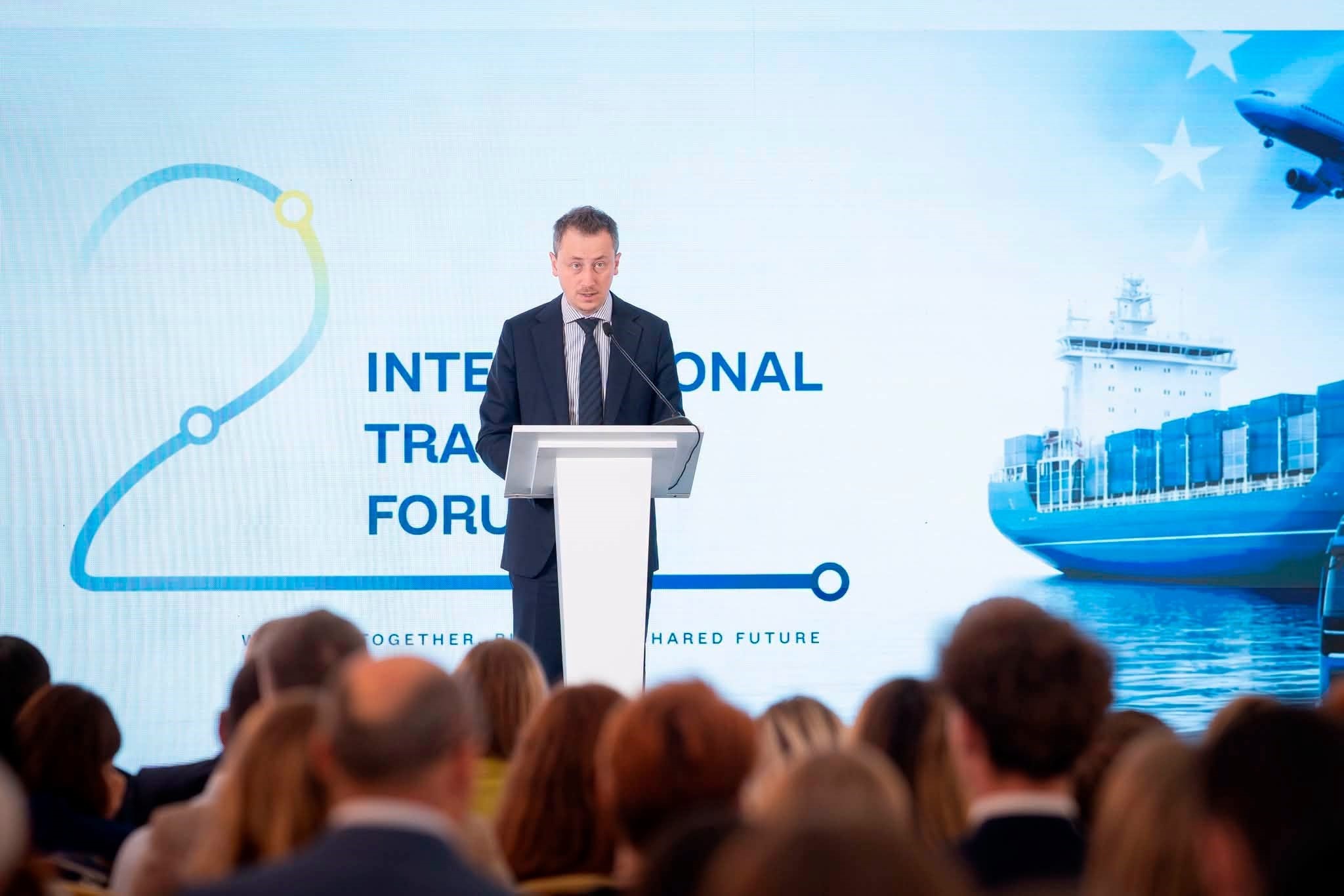
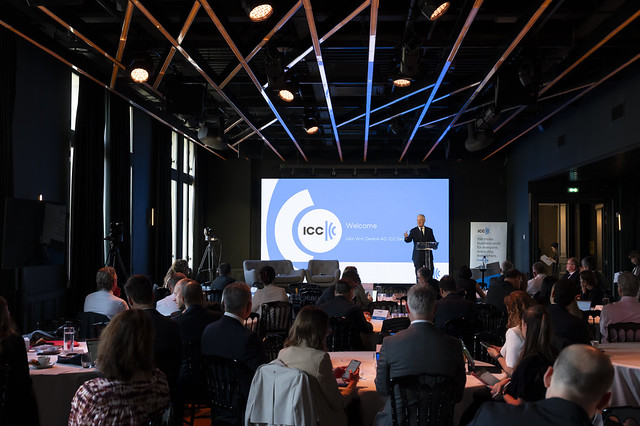
Representatives of ICC Ukraine joined the presentation of the Export Strategy of Ukraine until 2030, which took place during the Second International Trade Forum. The document defines the priorities for the development of Ukrainian exports for the coming years and envisions increasing the export of goods and services to 85 billion USD, raising its share in GDP to 33%, developing the export of high value-added products, and gradually moving away from a raw material-based economic model.
The event was attended by Taras Kachka, Vice Prime Minister for European and Euro-Atlantic Integration of Ukraine; Oleksii Sobolev, Minister of Economy, Environment, and Agriculture of Ukraine; as well as representatives of the European Union, the Embassy of Germany in Ukraine, the business community, and international organizations.
During the presentation, the Minister of Economy, Environment, and Agriculture of Ukraine, Oleksii Sobolev, emphasized: “$85 billion in exports by 2030 is an ambitious goal of the new Export Strategy of Ukraine. This strategic document is a roadmap for the development of Ukraine’s trade with the world for the coming years. We have the reserve for such growth—it lies in increasing the export of high value-added products. This will allow for increasing economic revenues, developing processing, creating new jobs, as well as overcoming export restrictions.”
As noted during the presentation by Deputy Minister Taras Vysotskyi, the Strategy, developed with the support of international partners, defines a joint action plan for the state, business, and donors to integrate Ukrainian producers into global value chains and deepen economic integration with the European Union.
The Strategy envisions increasing the share of services export to 25% and reducing the share of raw materials and low-processed goods to 59%. The implementation of the document will take place in two stages. In the first stage (2026-2028), the emphasis will be placed on digitalization, regulatory changes, and attracting investments. The interim goal for 2028 is set at an export volume of $80 billion, an export share in GDP of at least 31.2%, and a further reduction of the raw material component. The second stage (2029-2030) involves deepening integration into the EU single market, attracting transnational companies, and opening trade representative offices abroad.
The Strategy focuses as much as possible on supporting small and medium-sized enterprises (SMEs) as one of the key drivers of economic growth. For small producers, the document provides for the launch of grant programs for pre-export preparation within the country and clear coordination of international donor assistance through the “Export Alliance” single window. To support Ukrainian manufacturers abroad, an online platform called “Trade Protection of Ukraine” is being launched. To eliminate fragmented management, dedicated export authorized officers will appear in each regional state administration, and individual regional development plans for foreign economic activity will be developed in the regions.
“Small and medium-sized businesses often have a great idea and a high-quality product, but do not yet have the scale to independently cover the costs of analytics or exhibition activities. Our priority is to provide small producers with ready ‘turnkey’ tools through the exporter’s electronic account and systematically support them at international venues. In particular, up to 10 million UAH is provided to compensate the cost of collective national stands for industry associations at international exhibitions. We are creating a single window where businesses receive reliable support from the ‘Made in Ukraine’ brand and direct access to promising EU markets,” Taras Vysotskyi emphasized.
A separate focus in the Strategy is placed on the development of export logistics. In particular, there are plans to launch regular transportation services based on PrJSC “Ukrainian Danube Shipping Company,” which will allow for the consolidation of cargo in Danube ports and its delivery to major ports for subsequent maritime export. It also provides for the reform of the railway tariff system in accordance with the EU market model.
Monitoring of the Strategy’s implementation will be carried out on an ongoing basis: the responsible bodies will report every six months, and the government will review the first annual report by February 1, 2027.
For ICC Ukraine, participation in the event was an opportunity to join the professional discussion on the further development of Ukraine’s export potential, tools to support Ukrainian exporters, and strengthening the integration of domestic business into the global economy.
Based on materials and photos from https://me.gov.ua/News/List?lang=uk-UA&tag=News
Last news
Agro Ukraine Week 2026: Three Days That United Agrarian Ukraine
From June 17 to 19, 2026, the International Agrarian Week "Agro Ukraine Week 2026" took place in Kyiv. It was…
24.06.2026
New ICC Arbitration Rules from June 2026: Faster, Clearer, More User-Friendly
The International Chamber of Commerce (ICC) has adopted an updated version of its Arbitration Rules. The new rules came into…
22.06.2026
ICC Ukraine’s Participation in the World Council Meeting during ICC Week 2026
On June 11, 2026, the meeting of the World Council, the highest governing body of the International Chamber of Commerce…
17.06.2026
ICC Ukraine at ICC Week 2026
On June 10, Tetiana Savosko, Executive Director of ICC Ukraine, took part in the ICC Permanent Heads Meeting and a…
16.06.2026
ICC Week 2026: Representatives of ICC Ukraine Actively Participated in the Work of ICC National Committees
Within the framework of ICC Week 2026, representatives of ICC Ukraine actively participated in the work of ICC national committees…
15.06.2026
Security of Foreign Economic Activity and Fraud Protection: ICC Ukraine and SIDCON Held a Practical Webinar for Exporters
On June 3, 2026, the Ukrainian National Committee of the International Chamber of Commerce (ICC Ukraine), in cooperation with the…
04.06.2026
eATA Carnet
The eATA Carnet system digitalizes traditional paper ATA Carnets and their lifecycle management process, allowing users to initiate and track…

02.06.2026
Ukraine needs an “Infrastructure Ramstein” to support railways and logistics during the war
Volodymyr Shchelkunov, Chair the of ICC Ukraine: — The fifth year of the full-scale war has demonstrated that Ukraine’s transport…

01.06.2026
Ukrainian Business in Switzerland: ICC Ukraine Hosted a Practical Webinar for Entrepreneurs
How to Turn the "Expensive and Complex" Stereotype into a Working Success Strategy? On April 29, the International Chamber of…

06.05.2026
ICC Ukraine and the Ukrainian Bar Association have signed a memorandum of cooperation
The Ukrainian National Committee of the International Chamber of Commerce (ICC Ukraine) and the Ukrainian Bar Association (UBA) have signed…

28.04.2026
Integration Forum “Paths and Financing for the Recovery of Territorial Communities: Strategy 2026” in Ivano-Frankivsk
April 23, 2026, in Ivano-Frankivsk, the Integration Forum “Paths and Financing for the Recovery of Territorial Communities: Strategy 2026” took…

27.04.2026
Funding for reconstruction, the development of social housing, and the role of developers and municipalities were discussed at the Recovery Construction Forum Ukraine 3.0
Funding for reconstruction, the development of social housing, and the role of developers and municipalities were discussed during the RECOVERY…

24.04.2026
Agro Ukraine Week 2026: Three Days That United Agrarian Ukraine
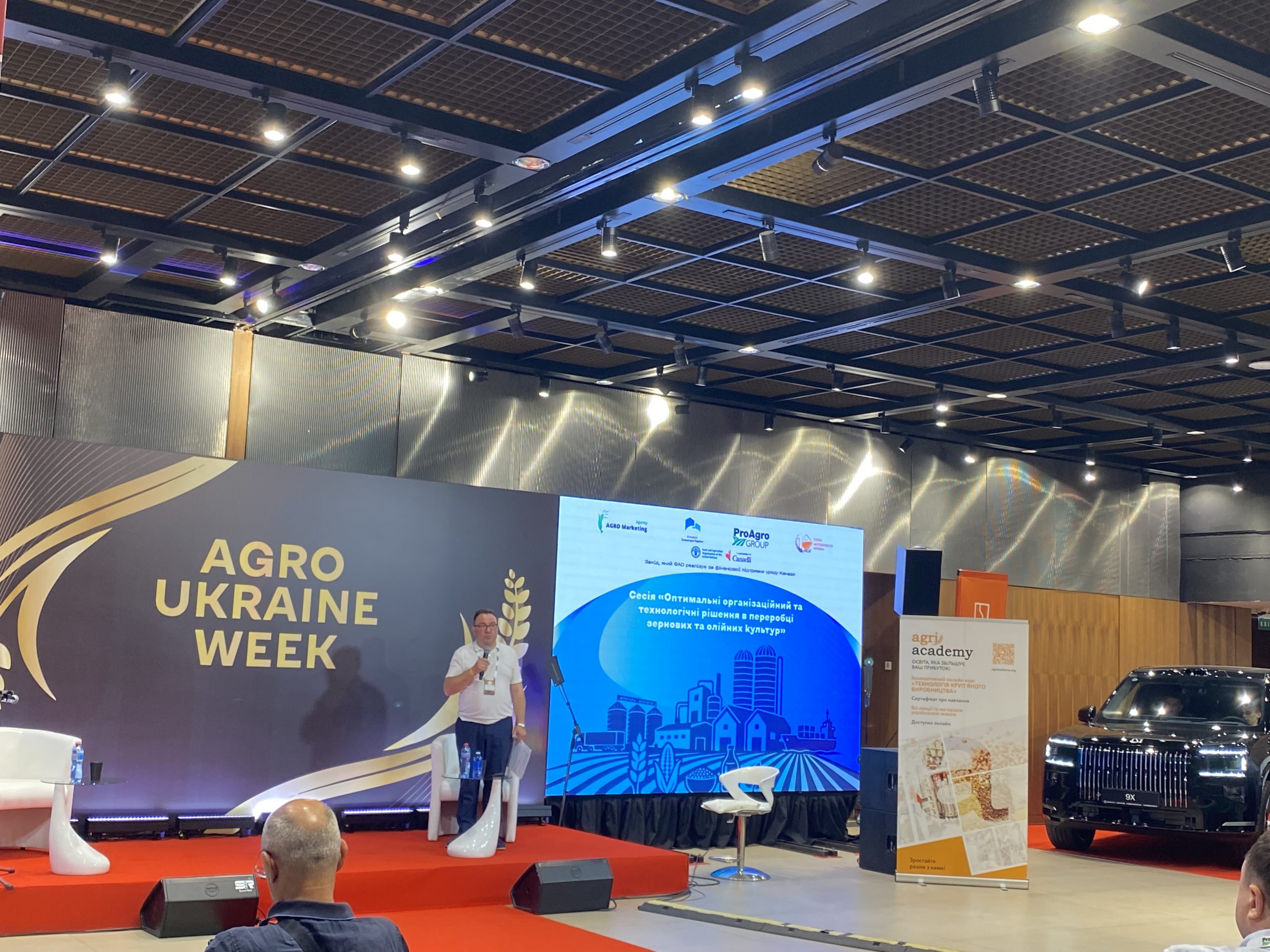
redactor From June 17 to 19, 2026, the International Agrarian Week “Agro Ukraine Week 2026” took place in Kyiv. It was the first event in Ukraine of such scale and format, unique in its concept and prospects. A business platform that united several industries and sectors, modeled after leading international exhibition and forum formats, it is set to become one of the key industry platforms in Europe within a few years in post-war Ukraine.
ICC Ukraine acted as an information partner for Agro Ukraine Week 2026.
Agro Ukraine Week represents the integration of specialized conferences, exhibitions, dialogue platforms, and cultural and educational events aimed not only at developing the national agro-industrial complex but also at raising the prestige of Ukraine as a modern agrarian state—a country associated with innovations, technologies, and the creation of high value-added products.
The first step is always a risk. However, the debut Agro Ukraine Week confirmed the demand for such a format and laid the foundation for the further development and improvement of the project. We thank everyone who, despite the difficult security situation and logistical risks, joined in holding the event.
Informal communication became a leading component of Agro Ukraine Week. Behind the scenes of the summit conferences, on the terraces, and in cozy relaxation zones, participants exchanged views, discussed pressing issues of industry development, and found new common ground for cooperation.
The exhibition area, featuring more than a hundred stands presented by leading suppliers of goods, services, and technologies for agricultural producers, became an important platform of the event. Without exaggeration, the groundwork for many future partnerships, joint projects, and business initiatives was laid here.
War is our reality. There is not a single industry, not a single enterprise that has not been affected by the hostilities, constant shelling, and their consequences. And so many farmers are defending our Motherland on the front lines! This theme resonated across all platforms: honoring the memory of Heroes, a performance by the Veterans’ Theater, and a screening of the film “Quiet Land” from the program of the “Molodist” film festival.
The main goal of the cultural and artistic program of the International Agrarian Week was to showcase genuine Ukrainian culture—without cheap stereotypes or vulgarity. Patriotic songs, fiery folk dances, Ukrainian folklore performed by the country’s leading artistic ensembles, an exhibition of works by our ingenious artist Ivan Marchuk, and presentations of exquisite brands enhanced the special atmosphere of Agro Ukraine Week, where professionalism unites with Ukrainian culture and art.
Fourteen forums, conferences, and summits served as the working platforms for Agro Ukraine Week, each dedicated to a separate area of agricultural industry development.
Agro Ukraine Summit
The central event of the first day was the Agro Ukraine Summit. Participants discussed the current state of the agricultural sector under war conditions, food security issues, state support for producers, and the prospects for exporting Ukrainian products. Special attention was paid to the adaptation of the agri-food sector to EU standards and the further integration of Ukraine into the European market.
AgTech Forum
The AgTech Forum became the main platform for demonstrating digital technologies and innovations in the agricultural sector. The Aggeek team managed to gather highly charismatic specialists; the presentation of each of them and their participation in the “battle” with AI greatly interested the audience. Forum participants discussed the development of precision farming, the use of drones, digital platforms, artificial intelligence, and robotic production management systems. The forum confirmed that the digitalization of agribusiness in Ukraine continues to gain momentum even under war conditions.
Agro Ukraine Farming
On Farmers’ Day, the Forum “The Farmer’s Word in a Time of Great Change” was held with great success. Organized by the All-Ukrainian Congress of Farmers with the support of the international humanitarian organization Mercy Corps, the forum was dedicated to Ukrainian farmers. The event became a platform for an open dialogue between the farming community and state authorities regarding financing, government support, European integration, and the development of rural areas.
Agro Invest Forum
The investment forum operated throughout all three days of Agro Ukraine Week. Its participants analyzed opportunities for attracting investments, the entry of Ukrainian companies into international markets, and increasing the competitiveness of agricultural business. A significant part of the discussions was dedicated to the development of partnerships, reforming the regulatory environment, and searching for new financial instruments for the agricultural sector. Naturally, the topic of investments was also highlighted at other conferences and forums.
Agro Marketing Stage
This event became not just a platform for discussing modern marketing strategies, branding, and communications in the agricultural sector, but also a hub of creativity and artistry. Speakers shared practical cases, talked about the use of artificial intelligence, building strong brands, and forming effective marketing teams. The communication hackathon by Dentsu Ukraine, during which participants created marketing solutions in real time, aroused particular interest among the audience.
Grain Storage Forum
The Grain Storage Forum gathered representatives of the elevator industry, logistics companies, and grain traders. The focus was on ensuring sufficient capacity for crop storage, developing logistical infrastructure, and the energy resilience of enterprises. Challenges of wartime were discussed separately, including infrastructure destruction, staff shortages, and the need to modernize elevator complexes.
Innovative Technologies in Livestock Farming
The conference was dedicated to modern technologies in livestock farming and increasing production efficiency. On the agenda were issues of dairy cattle productivity, profitability of milk production, animal comfort, and the adaptation of farms to climate challenges.
Grain Processing Forum
The forum on the processing of grain and oilseed crops was dedicated to creating value-added products and developing domestic processing. Experts analyzed the prospects for the production of cereals, flour, pasta, starches, and other products. Participants emphasized the need to strengthen Ukraine’s position not only as an exporter of raw materials but also as a manufacturer of finished goods.
Processing in Livestock Farming
The conference brought together representatives of the dairy processing industry. The key topics were the long-term development strategy of the dairy industry, increasing the competitiveness of Ukrainian products, and adaptation to European requirements. Additionally, issues of popularizing milk consumption and implementing school nutrition programs were actively discussed.
Vet Agro Forum
The Vet Agro Forum served as a professional platform for veterinarians, scientists, and representatives of livestock enterprises. The main focus was on disease prevention, animal welfare, the use of modern veterinary drugs, and the harmonization of Ukrainian legislation with EU requirements. Participants stressed the need to transition to systemic prevention.
All-Ukrainian Contest “Power of Agro-Changes”
Within the framework of Agro Ukraine Week, the results of the All-Ukrainian contest “Power of Agro-Changes” by the Agroportal publication were also finalized. With the support of partners, an award ceremony for the most innovative farmers of Ukraine took place on the main stage.
Solar Agro Conference
The conference was dedicated to the development of solar energy in the agricultural sector. Speakers presented practical cases of implementing solar power plants, energy storage systems, and agrovoltaic solutions. Energy efficiency is one of the key factors in the resilience of agricultural business under wartime risks.
Bioenergy Conference
At the center of attention of the Bioenergy Conference were the opportunities for biomass utilization and the development of biogas projects. Experts spoke about modern technologies for alternative energy production, the economics of bioenergy enterprises, and project financing. Legislative changes necessary to accelerate the development of the industry were discussed separately.
AgroBuild Ukraine
AgroBuild Ukraine united representatives of the construction and agricultural industries around the theme of rebuilding and modernizing agricultural infrastructure. Participants considered new safety standards, the digitalization of permitting procedures, prospects for exporting Ukrainian building materials, and the role of construction in the recovery of the agricultural sector.
The organizers express their great gratitude to all participants of the International Week, to all partners who supported the hosting of this large-scale event, and to all information partners and agro-bloggers who helped many farmers learn about Agro Ukraine Week 2026 and published news from the forums.
A low bow to the Armed Forces of Ukraine for the opportunity to work, develop the agricultural industry, meet at professional events, and build the future of our country!
The first experience of Agro Ukraine Week proved to be successful. Over its three days of operation, the event brought together more than three thousand representatives of the agrarian community, confirmed the relevance of the chosen format, and identified new directions for development in the coming years.
See you at Agro Ukraine Week 2027!!!
Based on materials from https://www.proagroukraine.com/
Last news
The Government Presented the Export Strategy of Ukraine until 2030
Representatives of ICC Ukraine joined the presentation of the Export Strategy of Ukraine until 2030, which took place during the…
13.07.2026
New ICC Arbitration Rules from June 2026: Faster, Clearer, More User-Friendly
The International Chamber of Commerce (ICC) has adopted an updated version of its Arbitration Rules. The new rules came into…
22.06.2026
ICC Ukraine’s Participation in the World Council Meeting during ICC Week 2026
On June 11, 2026, the meeting of the World Council, the highest governing body of the International Chamber of Commerce…
17.06.2026
ICC Ukraine at ICC Week 2026
On June 10, Tetiana Savosko, Executive Director of ICC Ukraine, took part in the ICC Permanent Heads Meeting and a…
16.06.2026
ICC Week 2026: Representatives of ICC Ukraine Actively Participated in the Work of ICC National Committees
Within the framework of ICC Week 2026, representatives of ICC Ukraine actively participated in the work of ICC national committees…
15.06.2026
Security of Foreign Economic Activity and Fraud Protection: ICC Ukraine and SIDCON Held a Practical Webinar for Exporters
On June 3, 2026, the Ukrainian National Committee of the International Chamber of Commerce (ICC Ukraine), in cooperation with the…
04.06.2026
eATA Carnet
The eATA Carnet system digitalizes traditional paper ATA Carnets and their lifecycle management process, allowing users to initiate and track…
02.06.2026
Ukraine needs an “Infrastructure Ramstein” to support railways and logistics during the war
Volodymyr Shchelkunov, Chair the of ICC Ukraine: — The fifth year of the full-scale war has demonstrated that Ukraine’s transport…
01.06.2026
Ukrainian Business in Switzerland: ICC Ukraine Hosted a Practical Webinar for Entrepreneurs
How to Turn the "Expensive and Complex" Stereotype into a Working Success Strategy? On April 29, the International Chamber of…
06.05.2026
ICC Ukraine and the Ukrainian Bar Association have signed a memorandum of cooperation
The Ukrainian National Committee of the International Chamber of Commerce (ICC Ukraine) and the Ukrainian Bar Association (UBA) have signed…
28.04.2026
Integration Forum “Paths and Financing for the Recovery of Territorial Communities: Strategy 2026” in Ivano-Frankivsk
April 23, 2026, in Ivano-Frankivsk, the Integration Forum “Paths and Financing for the Recovery of Territorial Communities: Strategy 2026” took…
27.04.2026
Funding for reconstruction, the development of social housing, and the role of developers and municipalities were discussed at the Recovery Construction Forum Ukraine 3.0
Funding for reconstruction, the development of social housing, and the role of developers and municipalities were discussed during the RECOVERY…
24.04.2026
New ICC Arbitration Rules from June 2026: Faster, Clearer, More User-Friendly
redactor The International Chamber of Commerce (ICC) has adopted an updated version of its Arbitration Rules. The new rules came into force on June 1, 2026, and strengthen international arbitration, particularly in the areas of efficiency, clarity, and user-friendliness.
With this reform, the ICC is responding to the growing demands of international commercial disputes and the increasing complexity of cross-border proceedings. The reform encompasses a series of changes to procedural rules aimed at more efficient management of proceedings, greater clarity in organizational matters, and a more comprehensive consideration of current trends in international arbitration practice.
The most significant innovations include, in particular:
-
a new Highly Expedited Procedure: an accelerated proceeding for disputes with a lower amount in dispute, enabling companies to resolve disputes faster and at a lower cost;
-
simplification of the course of proceedings thanks to the abolition of the traditional Terms of Reference;
-
more precise provisions regarding the organization and conduct of proceedings;
-
adaptation to current trends in international arbitration practice.
“Particularly in geopolitically and economically challenging times, companies need efficient, neutral, and internationally recognized dispute resolution mechanisms. The new ICC Arbitration Rules make an important contribution to this. The ICC reaffirms once again that it is a reliable and flexible institution whose regulations keep pace with the requirements of global economic practice,” notes Oliver Wieck, Secretary General of ICC Germany.
Current case statistics underscore the importance of ICC arbitration in international business transactions. In 2025, a total of 894 new proceedings were registered, 881 of which were under the ICC Arbitration Rules. At the end of the year, 1,869 proceedings were pending — a new record in the institution’s history. Furthermore, at the end of 2025, the ICC International Court of Arbitration registered its 30,000th case.
ICC arbitration is among the world’s leading mechanisms for resolving international commercial disputes. Parties from all regions of the world have for decades trusted the neutrality, enforceability, and high quality of ICC proceedings.
The new ICC Arbitration Rules can be viewed here.
Last news
The Government Presented the Export Strategy of Ukraine until 2030
Representatives of ICC Ukraine joined the presentation of the Export Strategy of Ukraine until 2030, which took place during the…
13.07.2026
Agro Ukraine Week 2026: Three Days That United Agrarian Ukraine
From June 17 to 19, 2026, the International Agrarian Week "Agro Ukraine Week 2026" took place in Kyiv. It was…
24.06.2026
ICC Ukraine’s Participation in the World Council Meeting during ICC Week 2026
On June 11, 2026, the meeting of the World Council, the highest governing body of the International Chamber of Commerce…
17.06.2026
ICC Ukraine at ICC Week 2026
On June 10, Tetiana Savosko, Executive Director of ICC Ukraine, took part in the ICC Permanent Heads Meeting and a…
16.06.2026
ICC Week 2026: Representatives of ICC Ukraine Actively Participated in the Work of ICC National Committees
Within the framework of ICC Week 2026, representatives of ICC Ukraine actively participated in the work of ICC national committees…
15.06.2026
Security of Foreign Economic Activity and Fraud Protection: ICC Ukraine and SIDCON Held a Practical Webinar for Exporters
On June 3, 2026, the Ukrainian National Committee of the International Chamber of Commerce (ICC Ukraine), in cooperation with the…
04.06.2026
eATA Carnet
The eATA Carnet system digitalizes traditional paper ATA Carnets and their lifecycle management process, allowing users to initiate and track…
02.06.2026
Ukraine needs an “Infrastructure Ramstein” to support railways and logistics during the war
Volodymyr Shchelkunov, Chair the of ICC Ukraine: — The fifth year of the full-scale war has demonstrated that Ukraine’s transport…
01.06.2026
Ukrainian Business in Switzerland: ICC Ukraine Hosted a Practical Webinar for Entrepreneurs
How to Turn the "Expensive and Complex" Stereotype into a Working Success Strategy? On April 29, the International Chamber of…
06.05.2026
ICC Ukraine and the Ukrainian Bar Association have signed a memorandum of cooperation
The Ukrainian National Committee of the International Chamber of Commerce (ICC Ukraine) and the Ukrainian Bar Association (UBA) have signed…
28.04.2026
Integration Forum “Paths and Financing for the Recovery of Territorial Communities: Strategy 2026” in Ivano-Frankivsk
April 23, 2026, in Ivano-Frankivsk, the Integration Forum “Paths and Financing for the Recovery of Territorial Communities: Strategy 2026” took…
27.04.2026
Funding for reconstruction, the development of social housing, and the role of developers and municipalities were discussed at the Recovery Construction Forum Ukraine 3.0
Funding for reconstruction, the development of social housing, and the role of developers and municipalities were discussed during the RECOVERY…
24.04.2026
ICC Ukraine’s Participation in the World Council Meeting during ICC Week 2026
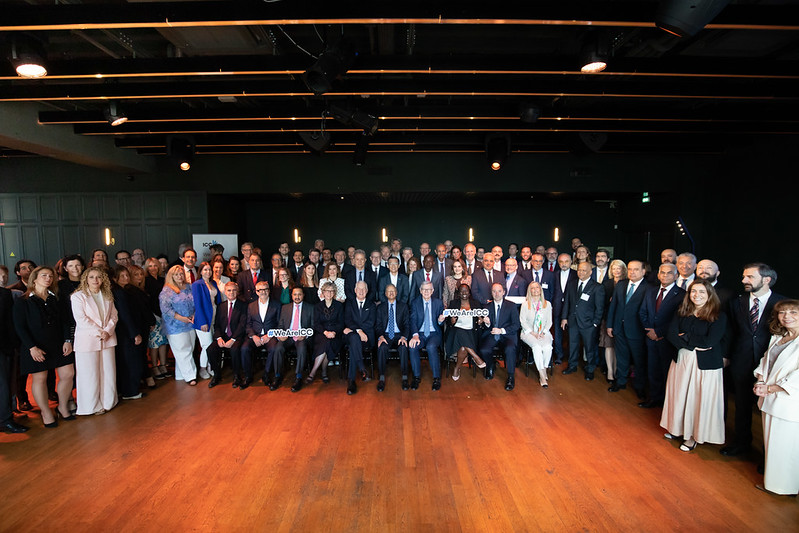
redactor On June 11, 2026, the meeting of the World Council, the highest governing body of the International Chamber of Commerce (ICC), took place in Paris, concluding the program of the large-scale ICC Week events. The meeting was attended by delegates from national committees worldwide, including representatives of the Ukrainian National Committee of the International Chamber of Commerce.
ICC Ukraine was represented at the event by Executive Director Tetiana Savosko, who participated in the voting and discussion of key agenda items.
During the meeting, World Council participants reviewed reports from the ICC leadership and headquarters regarding the organization’s current activities, the implementation of strategic initiatives, and the results of the global network’s work. Particular attention was paid to defining future priorities, strengthening the role of national committees, and implementing transformational changes within the framework of the Phoenix project.
The key event of the meeting was the official election of the new ICC Chair, Harsh Pati Singhania. In this position, he will lead the world’s largest business organization and determine its strategic development for the coming years.
Discussions also raised issues regarding the activities and development of ICC Ukraine, particularly the process of updating the national committee’s Statute in accordance with modern standards of corporate governance and the recommendations of the International Chamber of Commerce.
Participation in the World Council meeting was the final stage of the intense ICC Week 2026 program. This event once again demonstrated the active integration and significant role of ICC Ukraine in the activities of the global ICC network, which consolidates business communities from over 170 countries worldwide.
Last news
The Government Presented the Export Strategy of Ukraine until 2030
Representatives of ICC Ukraine joined the presentation of the Export Strategy of Ukraine until 2030, which took place during the…
13.07.2026
Agro Ukraine Week 2026: Three Days That United Agrarian Ukraine
From June 17 to 19, 2026, the International Agrarian Week "Agro Ukraine Week 2026" took place in Kyiv. It was…
24.06.2026
New ICC Arbitration Rules from June 2026: Faster, Clearer, More User-Friendly
The International Chamber of Commerce (ICC) has adopted an updated version of its Arbitration Rules. The new rules came into…
22.06.2026
ICC Ukraine at ICC Week 2026
On June 10, Tetiana Savosko, Executive Director of ICC Ukraine, took part in the ICC Permanent Heads Meeting and a…
16.06.2026
ICC Week 2026: Representatives of ICC Ukraine Actively Participated in the Work of ICC National Committees
Within the framework of ICC Week 2026, representatives of ICC Ukraine actively participated in the work of ICC national committees…
15.06.2026
Security of Foreign Economic Activity and Fraud Protection: ICC Ukraine and SIDCON Held a Practical Webinar for Exporters
On June 3, 2026, the Ukrainian National Committee of the International Chamber of Commerce (ICC Ukraine), in cooperation with the…
04.06.2026
eATA Carnet
The eATA Carnet system digitalizes traditional paper ATA Carnets and their lifecycle management process, allowing users to initiate and track…
02.06.2026
Ukraine needs an “Infrastructure Ramstein” to support railways and logistics during the war
Volodymyr Shchelkunov, Chair the of ICC Ukraine: — The fifth year of the full-scale war has demonstrated that Ukraine’s transport…
01.06.2026
Ukrainian Business in Switzerland: ICC Ukraine Hosted a Practical Webinar for Entrepreneurs
How to Turn the "Expensive and Complex" Stereotype into a Working Success Strategy? On April 29, the International Chamber of…
06.05.2026
ICC Ukraine and the Ukrainian Bar Association have signed a memorandum of cooperation
The Ukrainian National Committee of the International Chamber of Commerce (ICC Ukraine) and the Ukrainian Bar Association (UBA) have signed…
28.04.2026
Integration Forum “Paths and Financing for the Recovery of Territorial Communities: Strategy 2026” in Ivano-Frankivsk
April 23, 2026, in Ivano-Frankivsk, the Integration Forum “Paths and Financing for the Recovery of Territorial Communities: Strategy 2026” took…
27.04.2026
Funding for reconstruction, the development of social housing, and the role of developers and municipalities were discussed at the Recovery Construction Forum Ukraine 3.0
Funding for reconstruction, the development of social housing, and the role of developers and municipalities were discussed during the RECOVERY…
24.04.2026
ICC Ukraine at ICC Week 2026
redactor On June 10, Tetiana Savosko, Executive Director of ICC Ukraine, took part in the ICC Permanent Heads Meeting and a strategic session dedicated to shaping the vision for the organization’s development until 2035.
Oleksii Kozhanov, Secretary General of ICC Ukraine, also joined the session online, participating in the discussion on artificial intelligence and its impact on the future of business, international regulation, and global policy. Participants examined the role of ICC in shaping approaches to AI utilization, supporting business in the context of rapid technological changes, and developing international dialogue around new digital challenges.
During the strategic discussions, Tetiana Savosko joined the debate on the future of the ICC network, strengthening the organization’s global brand, and the role of national committees in developing the international business community. Special attention was paid to finding new formats of interaction with business, increasing the value of membership, and expanding international cooperation.
As part of the event, Tetiana had the opportunity to communicate with representatives from more than 20 countries, discussing common challenges and promising directions for cooperation between ICC national committees.
The day concluded with a closed dinner for heads of national committees with the participation of ICC Chair Philippe Varin. For ICC Ukraine, this was a valuable opportunity to continue the professional dialogue in an informal atmosphere and strengthen ties with the leaders of the global ICC network.
Participation in such events allows ICC Ukraine to be a part of shaping the future of the international business community and to represent the interests of Ukrainian business at the highest international level.
Ahead are even more outcomes and impressions from ICC Week 2026.
Last news
The Government Presented the Export Strategy of Ukraine until 2030
Representatives of ICC Ukraine joined the presentation of the Export Strategy of Ukraine until 2030, which took place during the…
13.07.2026
Agro Ukraine Week 2026: Three Days That United Agrarian Ukraine
From June 17 to 19, 2026, the International Agrarian Week "Agro Ukraine Week 2026" took place in Kyiv. It was…
24.06.2026
New ICC Arbitration Rules from June 2026: Faster, Clearer, More User-Friendly
The International Chamber of Commerce (ICC) has adopted an updated version of its Arbitration Rules. The new rules came into…
22.06.2026
ICC Ukraine’s Participation in the World Council Meeting during ICC Week 2026
On June 11, 2026, the meeting of the World Council, the highest governing body of the International Chamber of Commerce…
17.06.2026
ICC Week 2026: Representatives of ICC Ukraine Actively Participated in the Work of ICC National Committees
Within the framework of ICC Week 2026, representatives of ICC Ukraine actively participated in the work of ICC national committees…
15.06.2026
Security of Foreign Economic Activity and Fraud Protection: ICC Ukraine and SIDCON Held a Practical Webinar for Exporters
On June 3, 2026, the Ukrainian National Committee of the International Chamber of Commerce (ICC Ukraine), in cooperation with the…
04.06.2026
eATA Carnet
The eATA Carnet system digitalizes traditional paper ATA Carnets and their lifecycle management process, allowing users to initiate and track…
02.06.2026
Ukraine needs an “Infrastructure Ramstein” to support railways and logistics during the war
Volodymyr Shchelkunov, Chair the of ICC Ukraine: — The fifth year of the full-scale war has demonstrated that Ukraine’s transport…
01.06.2026
Ukrainian Business in Switzerland: ICC Ukraine Hosted a Practical Webinar for Entrepreneurs
How to Turn the "Expensive and Complex" Stereotype into a Working Success Strategy? On April 29, the International Chamber of…
06.05.2026
ICC Ukraine and the Ukrainian Bar Association have signed a memorandum of cooperation
The Ukrainian National Committee of the International Chamber of Commerce (ICC Ukraine) and the Ukrainian Bar Association (UBA) have signed…
28.04.2026
Integration Forum “Paths and Financing for the Recovery of Territorial Communities: Strategy 2026” in Ivano-Frankivsk
April 23, 2026, in Ivano-Frankivsk, the Integration Forum “Paths and Financing for the Recovery of Territorial Communities: Strategy 2026” took…
27.04.2026
Funding for reconstruction, the development of social housing, and the role of developers and municipalities were discussed at the Recovery Construction Forum Ukraine 3.0
Funding for reconstruction, the development of social housing, and the role of developers and municipalities were discussed during the RECOVERY…
24.04.2026
ICC Week 2026: Representatives of ICC Ukraine Actively Participated in the Work of ICC National Committees
redactor Within the framework of ICC Week 2026, representatives of ICC Ukraine actively participated in the work of ICC national committees and professional discussions regarding the future development of the ICC network.
NC Session 4 was attended by Tetiana Savosko, Executive Director of ICC Ukraine. NC Session 5 “Project Phoenix: From Diagnosis to Action” was attended by ICC Ukraine Vice Chairs Marek Gawlik and Ihor Perepelkin.
The sessions served as an important platform for exchanging experience among national committees from different countries, discussing new approaches to the development of the ICC network, and improving the operations of national committees. The representatives of ICC Ukraine joined interactive discussions, the collaborative search for solutions, and the exchange of best practices with colleagues from around the world.
Participation in such meetings allows not only for adopting international experience but also for representing Ukrainian business on a global level and shaping the future of the ICC network together with partners from over 170 countries worldwide.
More wrap-ups, new acquaintances, and important meetings from ICC Week 2026 are still ahead.
Stay tuned for our updates!
Last news
The Government Presented the Export Strategy of Ukraine until 2030
Representatives of ICC Ukraine joined the presentation of the Export Strategy of Ukraine until 2030, which took place during the…
13.07.2026
Agro Ukraine Week 2026: Three Days That United Agrarian Ukraine
From June 17 to 19, 2026, the International Agrarian Week "Agro Ukraine Week 2026" took place in Kyiv. It was…
24.06.2026
New ICC Arbitration Rules from June 2026: Faster, Clearer, More User-Friendly
The International Chamber of Commerce (ICC) has adopted an updated version of its Arbitration Rules. The new rules came into…
22.06.2026
ICC Ukraine’s Participation in the World Council Meeting during ICC Week 2026
On June 11, 2026, the meeting of the World Council, the highest governing body of the International Chamber of Commerce…
17.06.2026
ICC Ukraine at ICC Week 2026
On June 10, Tetiana Savosko, Executive Director of ICC Ukraine, took part in the ICC Permanent Heads Meeting and a…
16.06.2026
Security of Foreign Economic Activity and Fraud Protection: ICC Ukraine and SIDCON Held a Practical Webinar for Exporters
On June 3, 2026, the Ukrainian National Committee of the International Chamber of Commerce (ICC Ukraine), in cooperation with the…
04.06.2026
eATA Carnet
The eATA Carnet system digitalizes traditional paper ATA Carnets and their lifecycle management process, allowing users to initiate and track…
02.06.2026
Ukraine needs an “Infrastructure Ramstein” to support railways and logistics during the war
Volodymyr Shchelkunov, Chair the of ICC Ukraine: — The fifth year of the full-scale war has demonstrated that Ukraine’s transport…
01.06.2026
Ukrainian Business in Switzerland: ICC Ukraine Hosted a Practical Webinar for Entrepreneurs
How to Turn the "Expensive and Complex" Stereotype into a Working Success Strategy? On April 29, the International Chamber of…
06.05.2026
ICC Ukraine and the Ukrainian Bar Association have signed a memorandum of cooperation
The Ukrainian National Committee of the International Chamber of Commerce (ICC Ukraine) and the Ukrainian Bar Association (UBA) have signed…
28.04.2026
Integration Forum “Paths and Financing for the Recovery of Territorial Communities: Strategy 2026” in Ivano-Frankivsk
April 23, 2026, in Ivano-Frankivsk, the Integration Forum “Paths and Financing for the Recovery of Territorial Communities: Strategy 2026” took…
27.04.2026
Funding for reconstruction, the development of social housing, and the role of developers and municipalities were discussed at the Recovery Construction Forum Ukraine 3.0
Funding for reconstruction, the development of social housing, and the role of developers and municipalities were discussed during the RECOVERY…
24.04.2026
Security of Foreign Economic Activity and Fraud Protection: ICC Ukraine and SIDCON Held a Practical Webinar for Exporters
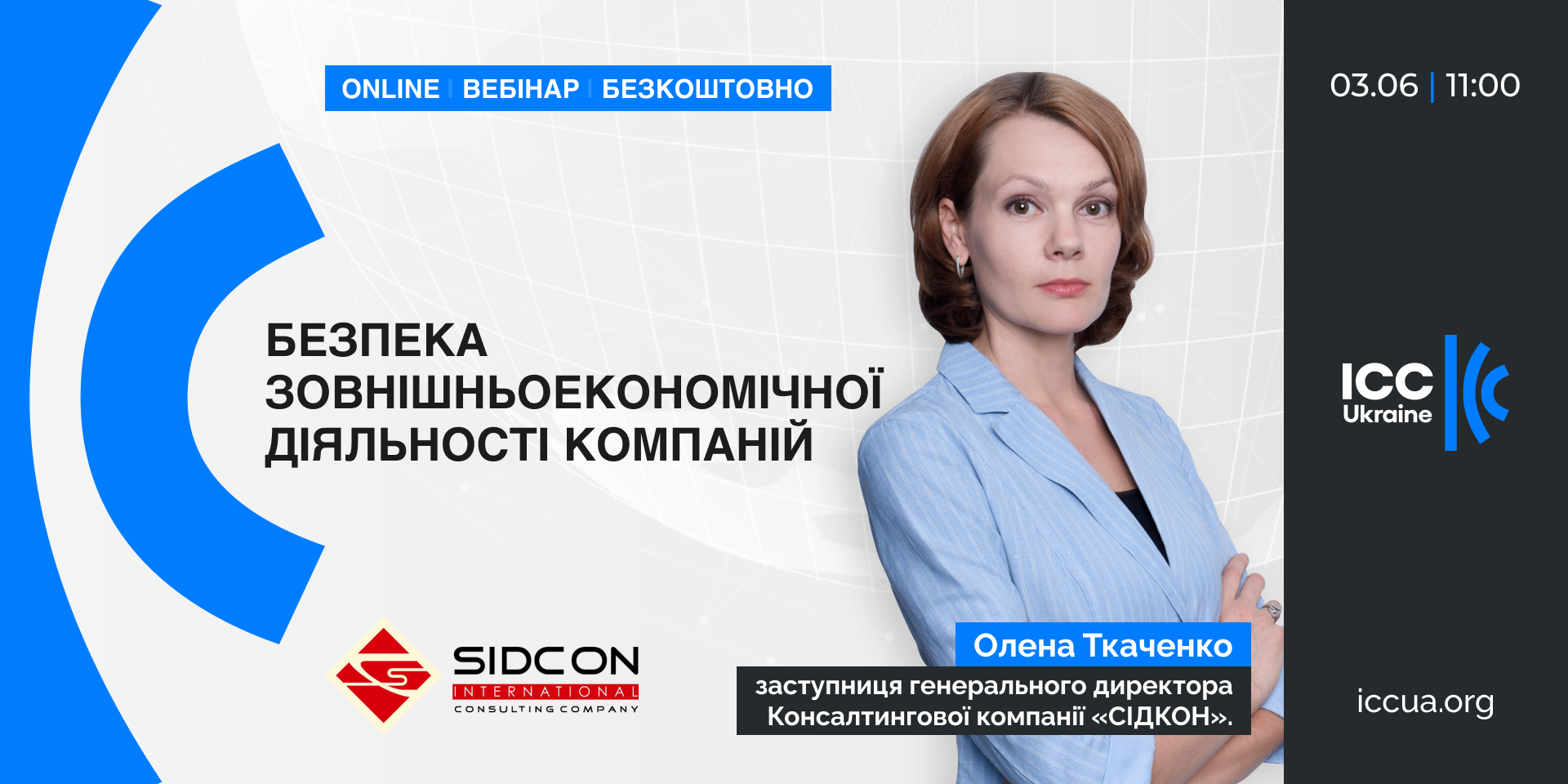
redactor On June 3, 2026, the Ukrainian National Committee of the International Chamber of Commerce (ICC Ukraine), in cooperation with the leading consulting company “SIDCON”, held an online webinar titled “Security of Foreign Economic Activity of Companies.” The event broughtmapSize Ukrainian entrepreneurs, heads of FEA departments, corporate lawyers, financiers, and representatives of corporate security services who are planning expansion into foreign markets or are already engaged in international activities.
Entering the international arena opens up large-scale prospects for Ukrainian business; however, the level of hidden threats and financial risks is significantly higher here than in the domestic market. The main objective of the webinar was to provide businesses with effective tools to minimize FEA risks and protect capital from international fraud.
Oleksii Kozhanov, Secretary General of ICC Ukraine, delivered the welcoming remarks to the participants. Olena Tkachenko, Deputy Director General of the “SIDCON” Consulting Company and an expert with years of experience in business security and applied analytics, served as the keynote speaker of the event.
During the webinar, the following strategic blocks were discussed in detail:
-
Export potential assessment: how to objectively determine a company’s readiness for scaling and which factors influence the development of successful expansion.
-
Market accessibility and analysis: a methodology for researching foreign markets, weighing potential risks and commercial prospects.
-
Countering international fraud: legal and financial aspects of the security of contractual relations with foreign partners.
-
Counterparty verification: a detailed breakdown of real cases and partner audit algorithms in the formats “before” signing a contract and “after” problems are detected.
-
Competitive intelligence: the role of applied intelligence as a central element in protecting the interests of Ukrainian companies when operating in new territories.
The speaker emphasized that it is critically important for Ukrainian companies to implement step-by-step algorithms of preventive protection as early as the contract preparation stage.
ICC Ukraine continues to systematically support domestic business by providing access to advanced analytics and expert solutions that facilitate the secure integration of Ukrainian companies into the global economic space.
The video recording of the webinar is available at the link: https://youtu.be/j3BPVnKKS4c
Last news
The Government Presented the Export Strategy of Ukraine until 2030
Representatives of ICC Ukraine joined the presentation of the Export Strategy of Ukraine until 2030, which took place during the…
13.07.2026
Agro Ukraine Week 2026: Three Days That United Agrarian Ukraine
From June 17 to 19, 2026, the International Agrarian Week "Agro Ukraine Week 2026" took place in Kyiv. It was…
24.06.2026
New ICC Arbitration Rules from June 2026: Faster, Clearer, More User-Friendly
The International Chamber of Commerce (ICC) has adopted an updated version of its Arbitration Rules. The new rules came into…
22.06.2026
ICC Ukraine’s Participation in the World Council Meeting during ICC Week 2026
On June 11, 2026, the meeting of the World Council, the highest governing body of the International Chamber of Commerce…
17.06.2026
ICC Ukraine at ICC Week 2026
On June 10, Tetiana Savosko, Executive Director of ICC Ukraine, took part in the ICC Permanent Heads Meeting and a…
16.06.2026
ICC Week 2026: Representatives of ICC Ukraine Actively Participated in the Work of ICC National Committees
Within the framework of ICC Week 2026, representatives of ICC Ukraine actively participated in the work of ICC national committees…
15.06.2026
eATA Carnet
The eATA Carnet system digitalizes traditional paper ATA Carnets and their lifecycle management process, allowing users to initiate and track…
02.06.2026
Ukraine needs an “Infrastructure Ramstein” to support railways and logistics during the war
Volodymyr Shchelkunov, Chair the of ICC Ukraine: — The fifth year of the full-scale war has demonstrated that Ukraine’s transport…
01.06.2026
Ukrainian Business in Switzerland: ICC Ukraine Hosted a Practical Webinar for Entrepreneurs
How to Turn the "Expensive and Complex" Stereotype into a Working Success Strategy? On April 29, the International Chamber of…
06.05.2026
ICC Ukraine and the Ukrainian Bar Association have signed a memorandum of cooperation
The Ukrainian National Committee of the International Chamber of Commerce (ICC Ukraine) and the Ukrainian Bar Association (UBA) have signed…
28.04.2026
Integration Forum “Paths and Financing for the Recovery of Territorial Communities: Strategy 2026” in Ivano-Frankivsk
April 23, 2026, in Ivano-Frankivsk, the Integration Forum “Paths and Financing for the Recovery of Territorial Communities: Strategy 2026” took…
27.04.2026
Funding for reconstruction, the development of social housing, and the role of developers and municipalities were discussed at the Recovery Construction Forum Ukraine 3.0
Funding for reconstruction, the development of social housing, and the role of developers and municipalities were discussed during the RECOVERY…
24.04.2026
eATA Carnet
redactor The eATA Carnet system digitalizes traditional paper ATA Carnets and their lifecycle management process, allowing users to initiate and track carnet declarations digitally at every stage of the goods’ cross-border movement.
Cross-border Operations Transition to a Paperless Format
In 2016, the eATA concept, developed by the ICC, was endorsed by the World Customs Organization (WCO) ATA/Istanbul Convention Administrative Committee. The eATA Carnet system modernizes the ATA Carnet procedure, enabling real-time management of carnets—from issuance and declaration to operations and claims—enhancing traceability and efficiency for all participants.
ATA Carnet procedures are expected to become fully digital worldwide by January 1, 2028.
What is the eATA Carnet System?
The digital ATA Carnet system, also known as the eATA Carnet system, is a suite of digital tools implemented by the ICC to digitalize the paper-based ATA Carnet procedure. Developed to meet the needs of both customs officers and regular users, the digital ATA Carnet system consists of:
-
ATA Carnet Core: The central engine and database that connects all digital components and ensures secure data exchange.
-
ATA Carnet Customs: A ready-to-use web portal that allows customs officers to verify carnets and approve transactions declared in a digital format.
-
ATA Carnet App: A secure mobile digital wallet for holders and representatives, designed for storing carnets and preparing declarations. A desktop version is also available to optimize the management of multiple carnets.

Following a successful pilot phase, the WCO ATA/Istanbul Convention Administrative Committee tasked the ICC with developing the Global Transition Plan (GTP) for eATA. Customs administrations ready to use the system can transition to the digital ATA Carnet procedure by following the Customs Preparation Guide and Readiness Checklist.
As of today, 30 countries (full list below) have announced their readiness to accept digital carnets and transition to the digital ATA Carnet procedure starting June 1, 2026. More customs administrations are expected to be ready for eATA by the end of 2027 at the latest.
How Does eATA Work?
-
From the perspective of holders:
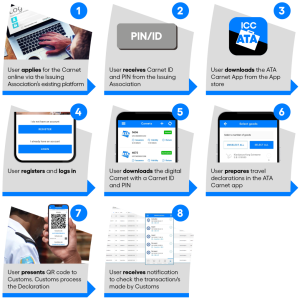
-
From the perspective of customs:

What Happens During the Digital Transition Phase (2026–2027)?
Customs administrations around the world will not transition to the digital procedure simultaneously. That is why the Global Transition Plan (GTP) for eATA, created by the ICC, was adopted by the WCO ATA/Istanbul Convention Administrative Committee to support customs during the eATA transition.
During the digital transition at the issuance stage, issuing chambers of commerce will issue ATA Carnets either in paper format (paper carnet), digital format (digital carnet), or both formats—depending on the requirements and digital readiness status of the countries/customs territories involved in the route.
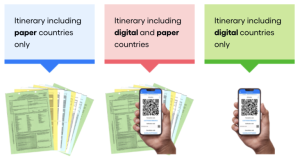
At customs checkpoints, holders and/or their representatives are required to present paper carnets in countries where customs accept only paper carnets (“paper” countries), and present digital carnets in countries where customs have already activated the use of digital carnets (digital countries). If any “paper” countries are involved in the route, paper carnets must always be validated, so certain types of operations in a mixed route will be performed in both formats.
Be sure to check the readiness of each country/territory (see the list below) on your route before departure.
The transition plan outlines six use cases demonstrating which format to apply depending on the digital readiness status of customs and the type of operation.
For comprehensive information on these scenarios, please refer to the Global Transition Plan (GTP) for eATA.
Digitalization Roadmap and Activation Dates
Countries/customs territories join the digital environment in accordance with confirmed readiness.
| Digital Country/Customs Territory* | Activation Date |
| European Union (27 Member States): Austria, Italy, Belgium, Latvia, Bulgaria, Lithuania, Croatia, Luxembourg, Cyprus, Malta, Czechia, Netherlands, Denmark, Poland, Estonia, Portugal, Finland, Romania, France, Slovakia, Germany, Slovenia, Greece, Spain, Hungary, Sweden, Ireland |
June 1, 2026 |
| Norway |
June 1, 2026 |
| Switzerland |
June 1, 2026 |
| United Kingdom |
June 1, 2026 |
*Contact your issuing association to confirm coverage in the extended or overseas territories of these countries.
More countries and customs territories will join as their readiness is confirmed. ATA Carnet procedures are expected to become fully digital worldwide by January 1, 2028.
Original: https://iccwbo.org/business-solutions/ata-carnet/eata-carnet/
Last news
The Government Presented the Export Strategy of Ukraine until 2030
Representatives of ICC Ukraine joined the presentation of the Export Strategy of Ukraine until 2030, which took place during the…
13.07.2026
Agro Ukraine Week 2026: Three Days That United Agrarian Ukraine
From June 17 to 19, 2026, the International Agrarian Week "Agro Ukraine Week 2026" took place in Kyiv. It was…
24.06.2026
New ICC Arbitration Rules from June 2026: Faster, Clearer, More User-Friendly
The International Chamber of Commerce (ICC) has adopted an updated version of its Arbitration Rules. The new rules came into…
22.06.2026
ICC Ukraine’s Participation in the World Council Meeting during ICC Week 2026
On June 11, 2026, the meeting of the World Council, the highest governing body of the International Chamber of Commerce…
17.06.2026
ICC Ukraine at ICC Week 2026
On June 10, Tetiana Savosko, Executive Director of ICC Ukraine, took part in the ICC Permanent Heads Meeting and a…
16.06.2026
ICC Week 2026: Representatives of ICC Ukraine Actively Participated in the Work of ICC National Committees
Within the framework of ICC Week 2026, representatives of ICC Ukraine actively participated in the work of ICC national committees…
15.06.2026
Security of Foreign Economic Activity and Fraud Protection: ICC Ukraine and SIDCON Held a Practical Webinar for Exporters
On June 3, 2026, the Ukrainian National Committee of the International Chamber of Commerce (ICC Ukraine), in cooperation with the…
04.06.2026
Ukraine needs an “Infrastructure Ramstein” to support railways and logistics during the war
Volodymyr Shchelkunov, Chair the of ICC Ukraine: — The fifth year of the full-scale war has demonstrated that Ukraine’s transport…
01.06.2026
Ukrainian Business in Switzerland: ICC Ukraine Hosted a Practical Webinar for Entrepreneurs
How to Turn the "Expensive and Complex" Stereotype into a Working Success Strategy? On April 29, the International Chamber of…
06.05.2026
ICC Ukraine and the Ukrainian Bar Association have signed a memorandum of cooperation
The Ukrainian National Committee of the International Chamber of Commerce (ICC Ukraine) and the Ukrainian Bar Association (UBA) have signed…
28.04.2026
Integration Forum “Paths and Financing for the Recovery of Territorial Communities: Strategy 2026” in Ivano-Frankivsk
April 23, 2026, in Ivano-Frankivsk, the Integration Forum “Paths and Financing for the Recovery of Territorial Communities: Strategy 2026” took…
27.04.2026
Funding for reconstruction, the development of social housing, and the role of developers and municipalities were discussed at the Recovery Construction Forum Ukraine 3.0
Funding for reconstruction, the development of social housing, and the role of developers and municipalities were discussed during the RECOVERY…
24.04.2026
Ukraine needs an “Infrastructure Ramstein” to support railways and logistics during the war
redactor Volodymyr Shchelkunov, Chair the of ICC Ukraine:
— The fifth year of the full-scale war has demonstrated that Ukraine’s transport infrastructure is no longer merely a part of the economy, but one of the key elements of national security, state resilience, and the functioning of the country. Under the current conditions, the railway has become Ukraine’s main transport artery. Due to the closed airspace, constant risks to maritime logistics, and limited capacities of road transportation, the burden on Ukrzaliznytsia is unprecedented.
In fact, today the railway simultaneously performs several strategic functions. These include the evacuation of the population from frontline regions, transportation of military and humanitarian cargo, ensuring the operation of enterprises, supporting exports and imports, as well as maintaining the stability of the domestic economy. Under such conditions, any strikes on railway infrastructure have not only local consequences, but also affect the resilience of the state as a whole.
That is why the issue of international support for Ukraine’s transport infrastructure is extremely relevant and requires a systematic approach. We have already seen examples of effective international coordination in the defense sector within the “Ramstein” format. In my opinion, Ukraine and its international partners should create a similar permanent coordination mechanism to support critical infrastructure and logistics.
This concerns the establishment of a kind of “Infrastructure Ramstein” that would operate on a permanent basis and ensure оперативне response to challenges. Such a mechanism should unite the governments of partner states, international financial organizations, development banks, transport companies, manufacturers of machinery, energy equipment, and specialized international associations.
It is especially important that assistance should not be limited solely to financing. Ukraine needs fast and practical solutions. First and foremost, this includes the supply of locomotives, railcars, energy equipment, transformers, signaling systems, automation tools, specialized repair equipment, and spare parts. It is also critically important to create an international reserve of critical equipment for the rapid restoration of damaged facilities after missile strikes.
We must understand that today the speed of infrastructure restoration has become one of the factors of state resilience. While previously the reconstruction of certain facilities could take months, now it is literally a matter of hours or days. And this is precisely where international support can play a decisive role — through simplified mechanisms of supply, financing, and technical coordination.
In addition, international insurance of transportation and logistics risks is another important area. Due to wartime threats, many international companies face high insurance rates or are not prepared to operate in the region at all. Therefore, international guarantee mechanisms are needed to help maintain cargo flows, investments, and the participation of foreign businesses in the restoration of Ukraine’s infrastructure.
Equally important is the integration of Ukraine’s transport system into the European logistics network. The war has effectively accelerated processes that were previously considered long-term. Today, Ukraine is already becoming an integral part of European transport corridors. This concerns the development of border infrastructure, increasing the capacity of border crossings, modernization of railway tracks, digitalization of logistics, and harmonization of transport standards.
For the international community, it is important to realize that supporting Ukrainian logistics is not only assistance to Ukraine. It is a matter of the stability of global markets, food security, continuity of international trade, and the economic security of Europe. Ukrainian railways ensure critically important exports of agricultural products, metallurgy, raw materials, and humanitarian cargo. Entire regions of the world depend on the stability of these transportation routes.
I would also like to emphasize separately that international support must not be reactive, but strategic. It is necessary already now to form joint long-term programs for the modernization of Ukraine’s transport infrastructure, taking into account post-war reconstruction and Ukraine’s future membership in the European Union.
Today, Ukraine is demonstrating unique experience in operating a transport system under the conditions of a full-scale war. And this experience is also valuable for international partners. Therefore, cooperation should be built not only as assistance to Ukraine, but as a joint formation of a new model of resilient, secure, and modern transport infrastructure for the whole of Europe.
Last news
The Government Presented the Export Strategy of Ukraine until 2030
Representatives of ICC Ukraine joined the presentation of the Export Strategy of Ukraine until 2030, which took place during the…
13.07.2026
Agro Ukraine Week 2026: Three Days That United Agrarian Ukraine
From June 17 to 19, 2026, the International Agrarian Week "Agro Ukraine Week 2026" took place in Kyiv. It was…
24.06.2026
New ICC Arbitration Rules from June 2026: Faster, Clearer, More User-Friendly
The International Chamber of Commerce (ICC) has adopted an updated version of its Arbitration Rules. The new rules came into…
22.06.2026
ICC Ukraine’s Participation in the World Council Meeting during ICC Week 2026
On June 11, 2026, the meeting of the World Council, the highest governing body of the International Chamber of Commerce…
17.06.2026
ICC Ukraine at ICC Week 2026
On June 10, Tetiana Savosko, Executive Director of ICC Ukraine, took part in the ICC Permanent Heads Meeting and a…
16.06.2026
ICC Week 2026: Representatives of ICC Ukraine Actively Participated in the Work of ICC National Committees
Within the framework of ICC Week 2026, representatives of ICC Ukraine actively participated in the work of ICC national committees…
15.06.2026
Security of Foreign Economic Activity and Fraud Protection: ICC Ukraine and SIDCON Held a Practical Webinar for Exporters
On June 3, 2026, the Ukrainian National Committee of the International Chamber of Commerce (ICC Ukraine), in cooperation with the…
04.06.2026
eATA Carnet
The eATA Carnet system digitalizes traditional paper ATA Carnets and their lifecycle management process, allowing users to initiate and track…
02.06.2026
Ukrainian Business in Switzerland: ICC Ukraine Hosted a Practical Webinar for Entrepreneurs
How to Turn the "Expensive and Complex" Stereotype into a Working Success Strategy? On April 29, the International Chamber of…
06.05.2026
ICC Ukraine and the Ukrainian Bar Association have signed a memorandum of cooperation
The Ukrainian National Committee of the International Chamber of Commerce (ICC Ukraine) and the Ukrainian Bar Association (UBA) have signed…
28.04.2026
Integration Forum “Paths and Financing for the Recovery of Territorial Communities: Strategy 2026” in Ivano-Frankivsk
April 23, 2026, in Ivano-Frankivsk, the Integration Forum “Paths and Financing for the Recovery of Territorial Communities: Strategy 2026” took…
27.04.2026
Funding for reconstruction, the development of social housing, and the role of developers and municipalities were discussed at the Recovery Construction Forum Ukraine 3.0
Funding for reconstruction, the development of social housing, and the role of developers and municipalities were discussed during the RECOVERY…
24.04.2026
Ukrainian Business in Switzerland: ICC Ukraine Hosted a Practical Webinar for Entrepreneurs
redactor How to Turn the “Expensive and Complex” Stereotype into a Working Success Strategy?
On April 29, the International Chamber of Commerce Ukraine (ICC Ukraine) held a webinar dedicated to the specifics of entering the Swiss market—one of the world’s most stable and prestigious jurisdictions.
The keynote speaker of the event was Oksana Hunda, Vice Chair of ICC Ukraine and Head of the Ukrainian International Trade Hub in Switzerland. She shared practical experience on how to properly enter a country where a stable legal system is combined with favorable taxation.
During the event, participants analyzed in detail the algorithm for choosing a canton and building an optimal tax strategy, taking into account the differences between federal, cantonal, and municipal taxes. Special attention was paid to the banking sector: the expert dispelled illusions regarding opening accounts for companies and individuals, and explained the mechanics of legal fund transfers from Ukraine, separating facts from common myths.
The webinar became a platform for professional discussion among entrepreneurs, financiers, and lawyers planning to scale their businesses or seeking new vectors for investment development.
ICC Ukraine continues to support Ukrainian business on the path to international expansion by providing verified expertise and practical tools.
Video recording of the webinar is available at the link: https://www.youtube.com/watch?v=PUjATO6DqtY
Follow our announcements so you don’t miss future events!
Last news
The Government Presented the Export Strategy of Ukraine until 2030
Representatives of ICC Ukraine joined the presentation of the Export Strategy of Ukraine until 2030, which took place during the…
13.07.2026
Agro Ukraine Week 2026: Three Days That United Agrarian Ukraine
From June 17 to 19, 2026, the International Agrarian Week "Agro Ukraine Week 2026" took place in Kyiv. It was…
24.06.2026
New ICC Arbitration Rules from June 2026: Faster, Clearer, More User-Friendly
The International Chamber of Commerce (ICC) has adopted an updated version of its Arbitration Rules. The new rules came into…
22.06.2026
ICC Ukraine’s Participation in the World Council Meeting during ICC Week 2026
On June 11, 2026, the meeting of the World Council, the highest governing body of the International Chamber of Commerce…
17.06.2026
ICC Ukraine at ICC Week 2026
On June 10, Tetiana Savosko, Executive Director of ICC Ukraine, took part in the ICC Permanent Heads Meeting and a…
16.06.2026
ICC Week 2026: Representatives of ICC Ukraine Actively Participated in the Work of ICC National Committees
Within the framework of ICC Week 2026, representatives of ICC Ukraine actively participated in the work of ICC national committees…
15.06.2026
Security of Foreign Economic Activity and Fraud Protection: ICC Ukraine and SIDCON Held a Practical Webinar for Exporters
On June 3, 2026, the Ukrainian National Committee of the International Chamber of Commerce (ICC Ukraine), in cooperation with the…
04.06.2026
eATA Carnet
The eATA Carnet system digitalizes traditional paper ATA Carnets and their lifecycle management process, allowing users to initiate and track…
02.06.2026
Ukraine needs an “Infrastructure Ramstein” to support railways and logistics during the war
Volodymyr Shchelkunov, Chair the of ICC Ukraine: — The fifth year of the full-scale war has demonstrated that Ukraine’s transport…
01.06.2026
ICC Ukraine and the Ukrainian Bar Association have signed a memorandum of cooperation
The Ukrainian National Committee of the International Chamber of Commerce (ICC Ukraine) and the Ukrainian Bar Association (UBA) have signed…
28.04.2026
Integration Forum “Paths and Financing for the Recovery of Territorial Communities: Strategy 2026” in Ivano-Frankivsk
April 23, 2026, in Ivano-Frankivsk, the Integration Forum “Paths and Financing for the Recovery of Territorial Communities: Strategy 2026” took…
27.04.2026
Funding for reconstruction, the development of social housing, and the role of developers and municipalities were discussed at the Recovery Construction Forum Ukraine 3.0
Funding for reconstruction, the development of social housing, and the role of developers and municipalities were discussed during the RECOVERY…
24.04.2026