
 +38(044)-234-42-73


Funding for reconstruction, the development of social housing, and the role of developers and municipalities were discussed at the Recovery Construction Forum Ukraine 3.0
 redactor
Funding for reconstruction, the development of social housing, and the role of developers and municipalities were discussed during the RECOVERY CONSTRUCTION FORUM UKRAINE 3.0, which took place on April 22.
The International Chamber of Commerce Ukraine is an information partner of the forum. Representing ICC Ukraine at the event were Svitlana Devochkina (Vice Chair for Ukraine’s Reconstruction) and Andriy Romanov (ICC Ukraine Banking Commission).

“Russia’s aggression continues to destroy Ukraine’s infrastructure and housing stock. In these circumstances, building a transparent and open construction market is a key prerequisite for development and European integration. At the same time, reconstruction cannot be limited to the public sector — the private sector plays a critically important role and has already demonstrated its resilience. Given growing needs and limited financing, it is essential to strengthen cooperation and create favorable conditions for business participation in recovery efforts,” emphasized Francesco Floris, First Counsellor and Trade Counsellor at the Delegation of the European Union to Ukraine, welcoming participants of the forum.
Opening remarks were also delivered by Oleksandr Chervak, CEO of the Confederation of Builders of Ukraine, and Olena Kononenko, Director of ReBuild Ukraine and Aquatherm exhibitions.
“The world is ready to invest; however, investors do not choose countries — they choose clear rules, speed, and trust. Our key tasks are to develop investment-ready projects, ensure transparent and predictable rules, and think at scale — at the level of systems, cities, and the economy. We are already competing globally for capital, and the question is how fast, clear, and reliable we can be. Reconstruction will happen — the question is who will deliver it and how,” noted Lev Partskhaladze, President of the Confederation of Builders of Ukraine, opening the first panel on financing, priorities, and implementation mechanisms for recovery projects.
The panel was co-moderated by Oleksandr Slobozhan, Executive Director of the Association of Ukrainian Cities.
From Financing to Implementation: Regulatory Framework
Olena Shuliak, Chair of the relevant committee of the Verkhovna Rada of Ukraine, outlined key legislative and regulatory prerequisites for moving from financing to implementation:
“Ukraine already has basic strategic and budgetary documents for recovery; however, a critical challenge remains the lack of up-to-date urban planning documentation, without which project implementation is impossible. The speed of preparation depends largely on the capacity of local governments. Despite postponing mandatory spatial development plans until 2028, progress remains slow. Effective reconstruction requires combining high-quality urban planning with the development of public-private partnership mechanisms.”
Nataliia Kozlovska presented the Ministry’s vision for modernizing construction regulation, improving permitting procedures, and introducing advanced project implementation tools:
“We are working on a comprehensive transformation of the construction sector — from regulation and permitting to project delivery tools. Particular attention is given to quality and the implementation of BIM technologies, which will enable businesses to work more effectively with public funds. We are also simplifying urban planning documentation and advancing reforms to make the rules clear and practical for the market.”
Financing Priorities and International Support
Kristina Mikulova, Head of the regional representation of the European Investment Bank (EIB), outlined the Bank’s approach to financing recovery projects:
She stressed the urgent need to prepare high-quality, investment-ready projects, as demand for financing significantly exceeds available resources. Priority sectors include social and critical infrastructure, particularly housing and water supply. Key financing conditions remain transparency, zero tolerance for corruption, financial sustainability, and expanded access to European programs.
Oleksandr Novytskyi highlighted key barriers at the start of construction and steps toward simplification and digitalization. The State Inspectorate of Architecture and Urban Planning of Ukraine is working to expand automated registrations and develop digital tools, including an AI assistant for verifying project documentation and identifying inconsistencies.
Oleksandr Kubrakov emphasized recovery priorities and conditions for attracting investment, noting the crucial role of the private sector. He highlighted the need for clear investment rules, transparent tariff policies, and expanded cooperation with international partners to mitigate risks.
Roman Komendant outlined approaches to project implementation, focusing on systemic infrastructure projects in logistics and water supply, supported by digital tools such as the DREAM ecosystem. He stressed the importance of public-private partnerships and integrated, district-level reconstruction.
Serhii Korenev shared practical experience at the municipal level, including a master plan developed with the United Nations Economic Commission for Europe focusing on water, energy, and waste management, with projects implemented in cooperation with international partners.
Housing Policy: From Compensation to New Stock
The second panel focused on housing policy and was moderated by Serhii Mamedov.
Ivan Parukh outlined approaches to stimulating demand, including housing vouchers and support programs.
Serhii Komnatnyi emphasized the importance of using international support not only for financing but also for knowledge transfer and institutional capacity building, including the development of social housing and regulated rental markets.
Andrii Tarasenko discussed scaling the “eOselia” mortgage program, noting growing demand and limited supply.
Serhii Zakharov presented a concept for affordable rental housing for internally displaced persons, including a flagship project in Bila Tserkva for over 1,100 families.
Dmytro Levytskyi outlined new approaches to social housing, emphasizing sustainability, inclusiveness, and financial viability, including a €100 million pilot project to build 1,500 apartments.
Business Access to Recovery Projects
The third panel, moderated by Denys Verhun and Ivan Slobodianyk, focused on practical tools for business participation in recovery projects.
Vitalii Petruk outlined key instruments supporting businesses in 2026, including the “Made in Ukraine” policy, localization, the “5–7–9%” financing program, and insurance and compensation mechanisms via the Export Credit Agency.
Mykola Ilinov highlighted program requirements and results, noting that total grants disbursed have reached UAH 4.7 billion.
Tetiana Korotka emphasized the growing number of business inquiries related to recovery projects and the importance of compliance, which is often underestimated by Ukrainian companies and limits their access to international contracts.
She stressed that effective participation requires a comprehensive approach, including strong infrastructure, access to financing, clear regulation, and reasonable participation costs.
Conclusions
Participation in Recovery Construction Forum 2026 confirmed that Ukraine’s recovery has moved from planning to active implementation. Direct dialogue with key stakeholders — including representatives of the government, Ukrainian cities, the EU, and the EIB — provided valuable insights into new initiatives, practical steps, programs, and financial instruments for restoring industrial capacity.
The forum proved to be an effective platform demonstrating that large-scale construction and modernization are already underway, while consolidated support from the government, municipalities, and international partners provides a solid foundation for remaining work, emphasized Andrii Romanov.

Organizers: Confederation of Builders of Ukraine and Premier Expo, an international exhibition operator
General Partner: Creator-Bud
Strategic Partner: XModule, Solidarity
Financial Partner: Globus Bank
Official Partners: Penetron Ukraine, Caparol Ukraine, TsGIP, Ruukki Ukraine
Media Partner: ICC Ukraine
Last news
The Government Presented the Export Strategy of Ukraine until 2030
Representatives of ICC Ukraine joined the presentation of the Export Strategy of Ukraine until 2030, which took place during the…
13.07.2026
Agro Ukraine Week 2026: Three Days That United Agrarian Ukraine
From June 17 to 19, 2026, the International Agrarian Week "Agro Ukraine Week 2026" took place in Kyiv. It was…
24.06.2026
New ICC Arbitration Rules from June 2026: Faster, Clearer, More User-Friendly
The International Chamber of Commerce (ICC) has adopted an updated version of its Arbitration Rules. The new rules came into…
22.06.2026
ICC Ukraine’s Participation in the World Council Meeting during ICC Week 2026
On June 11, 2026, the meeting of the World Council, the highest governing body of the International Chamber of Commerce…
17.06.2026
ICC Ukraine at ICC Week 2026
On June 10, Tetiana Savosko, Executive Director of ICC Ukraine, took part in the ICC Permanent Heads Meeting and a…
16.06.2026
ICC Week 2026: Representatives of ICC Ukraine Actively Participated in the Work of ICC National Committees
Within the framework of ICC Week 2026, representatives of ICC Ukraine actively participated in the work of ICC national committees…
15.06.2026
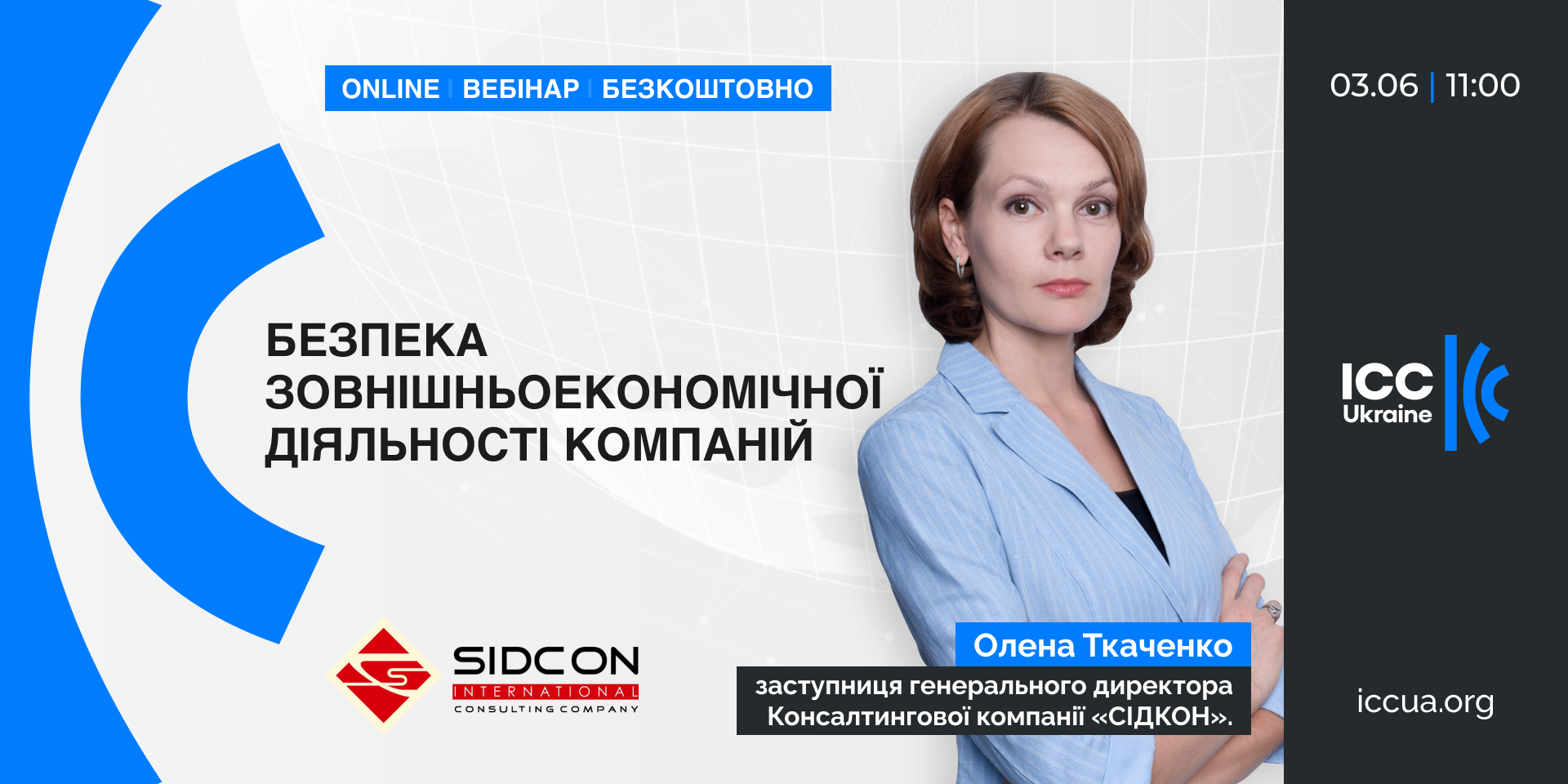
Security of Foreign Economic Activity and Fraud Protection: ICC Ukraine and SIDCON Held a Practical Webinar for Exporters
On June 3, 2026, the Ukrainian National Committee of the International Chamber of Commerce (ICC Ukraine), in cooperation with the…
04.06.2026
eATA Carnet
The eATA Carnet system digitalizes traditional paper ATA Carnets and their lifecycle management process, allowing users to initiate and track…

02.06.2026
Ukraine needs an “Infrastructure Ramstein” to support railways and logistics during the war
Volodymyr Shchelkunov, Chair the of ICC Ukraine: — The fifth year of the full-scale war has demonstrated that Ukraine’s transport…

01.06.2026
Ukrainian Business in Switzerland: ICC Ukraine Hosted a Practical Webinar for Entrepreneurs
How to Turn the "Expensive and Complex" Stereotype into a Working Success Strategy? On April 29, the International Chamber of…

06.05.2026
ICC Ukraine and the Ukrainian Bar Association have signed a memorandum of cooperation
The Ukrainian National Committee of the International Chamber of Commerce (ICC Ukraine) and the Ukrainian Bar Association (UBA) have signed…

28.04.2026
Integration Forum “Paths and Financing for the Recovery of Territorial Communities: Strategy 2026” in Ivano-Frankivsk
April 23, 2026, in Ivano-Frankivsk, the Integration Forum “Paths and Financing for the Recovery of Territorial Communities: Strategy 2026” took…

27.04.2026