
 +38(044)-234-42-73


The IMF, new taxes, and the government’s “silence”
 redactor
The following is the translation of the article by Dmytro Oleksiyenko, Chairman of the ICC Ukraine Tax Commission, published in Censor.NET. The author focuses on key aspects of the interaction between business and the state, highlighting the most acute issues that require the attention of the expert community and the authorities today.
At the end of 2025 – beginning of 2026, the International Monetary Fund was supposed to approve a new program for Ukraine in the amount of 8.1 billion USD. However, the Cabinet of Ministers’ proposals, previously agreed upon with the IMF, turned out to be so unacceptable for Ukrainian businesses and citizens that they did not find the necessary support among parliamentarians, who were asked to vote for these unpopular steps.
It should be recalled that a staff-level agreement between the IMF and the Ukrainian government was reached back in November 2025. But the Ministry of Finance, judging by the public testimony of deputies, did not conduct any systematic work with parliamentary factions to explain the content of the bills and ensure the necessary support. Instead, leading business associations and economic experts subjected the new taxes to devastating criticism.
Key proposed changes included: the introduction of VAT for Individual Entrepreneurs (FOPs) with a turnover exceeding 1 million UAH; the cancellation of the tax exemption for parcels up to 150 euros; the adoption of a law on the taxation of digital platforms; and the fixation of the 5% military levy even after the end of martial law.
Prime Minister Yuliia Svyrydenko stated on February 13 that certain compromises had been reached in the dialogue with the IMF — particularly regarding the VAT threshold for FOPs. There is also a discussion regarding moving tax changes from the status of prior conditions for program approval to the status of structural benchmarks.
Of the four key requirements of the new IMF program, the issue of VAT for individual entrepreneurs caused the greatest public outcry. The initial threshold of 1 million UAH per year was unrealistic: at this level, 670,000 FOPs would fall under mandatory VAT registration. The effective tax rate for them would have tripled — from approximately 6–7% today to 20–22%, if counting the single tax, military levy, and VAT together.
The current compromise consists of raising the threshold to 4 million UAH, which reduces the list of potential new VAT payers to approximately 260,000 entrepreneurs. The proposed figure for introducing VAT corresponds to the maximum threshold for VAT exemption for small businesses established by the EU Directive for small enterprises — 85,000 euros per year. At the current exchange rate, this is exactly about 4 million UAH.
Separately, it is worth noting: the threshold in hryvnias will devalue over time, while the real level of income will grow. To prevent the reform from turning into a mechanism for the constant expansion of the circle of VAT payers through inflation, a more rational decision would be to immediately fix the threshold directly in euros — given Ukraine’s declared course toward EU membership.
Raising the VAT threshold, however, does not solve the key problem — the administrative burden. VAT is one of the most complex taxes in terms of accounting, reporting, working with VAT invoices, and the risk of blocked accounts. For FOPs providing services, the transition to VAT means either a significant price increase for clients or a sharp decrease in profitability. For retail — an increase in retail prices. Without simultaneous simplification of the administration itself, VAT registration will turn into an additional incentive for the shadow economy.
The second block of tax reforms concerns the taxation of income received through digital platforms — taxi aggregators, marketplaces, rental, and freelance services. The government’s logic here seems more understandable: a significant volume of income in this sector exists in the shadows, while digital platforms have full information about all transactions. The digital economy in Ukraine is growing, and its taxation is justified. However, there are serious questions in the details of implementation.
First, the question of who will actually pay the new taxes. The experience of introducing VAT on electronic services of foreign companies in 2021 — the so-called “Google tax” — showed: large digital platforms do not absorb new fiscal costs but pass them on to consumers through increased prices or commissions. Streaming services, app stores, cloud platforms — everyone raised prices for Ukrainian users by exactly 20%. There is reason to expect that the new taxation for platforms will lead to an analogous result: commissions for sellers will increase, and they will raise prices for buyers. The average Ukrainian will remain the ultimate payer.
Second, the administrative burden placed on platform operators is disproportionate to the scale of their activities. A large international marketplace and a small local apartment rental service will receive the same obligations: to collect and verify the data of sellers and buyers, store it for five years, report quarterly, and in case of non-compliance — receive a fine in the amount of one hundred minimum wages. For small operators, this will be a critical burden that will jeopardize business profitability.
Third, the bill grants the State Tax Service (STS) new powers to access the banking information of accountable sellers, and the boundaries of this access are formulated quite broadly. In a country where the practice of arbitrary actions by tax authorities has long been documented by both the business community and the ombudsman, this is not a rhetorical problem.
A sensible solution would be phased implementation: first, voluntary connection to the data exchange system with tax incentives for participation, then a gradual transition to a mandatory regime. And most importantly — a parallel reform of the STS, which would make interaction with the tax authorities predictable and devoid of corruption risks.
The third issue — the cancellation of the customs exemption for parcels worth up to 150 euros — is the least justified in terms of both implementation timing and fiscal logic itself.
For example, in the EU, this discussion exists in a fundamentally different context: a single market, developed customs infrastructure, and a real competitive threat to local producers from Asian platforms. In Ukraine, a significant portion of parcels in this price range are personal use goods, gadgets, spare parts, as well as supplies for the front.
The fiscal effect of this measure will be limited and stretched over time — the administration of massive small parcels requires customs infrastructure that the State Customs Service currently does not have in sufficient volume. Instead, the social effect — the growth of retail prices — will manifest immediately and affect primarily the poorest segments of the population.
It is worth calling things by their names: the real lobbyists for this change are domestic retailers, interested in selling the same Chinese goods to Ukrainians through their own networks — and with a corresponding markup. This interest is quite understandable, but it should not be masked by fiscal arguments.
An alternative that achieves the same goal without a massive blow to the consumer exists: quantitative limits on exempt parcels per person per month or year. This approach is practiced in a number of countries and allows for separating personal consumption of such goods from commercial consumption.
The fourth block of reforms — fixing the 5% military levy rate after the conclusion of martial law — is the most strategically significant and at the same time the least publicly discussed. The current legal structure assumes that the 5% rate, introduced in December 2024, is temporary: after the cancellation of martial law, the levy automatically returns to 1.5%. The IMF insists on fixing the increased rate permanently — at least until the formal conclusion of hostilities and budget stabilization.
Arguments in favor of such an approach exist. In 2025, in the first four months alone, receipts from the military levy amounted to 163.6 billion. This is a significant source of income, and its sudden reduction, when defense spending needs remain substantial, represents a serious fiscal gap.
However, the question of the time horizon and conditions arises here. Permanently fixing the 5% rate — not as a transitional but as a base rate — contradicts the logic of post-war recovery. Private investments are sensitive to the level of taxation. A military levy rate of 5%, superimposed on the base Personal Income Tax (PIT) rate of 18%, gives an effective taxation level for personal income of 23%. This is noticeably higher than in most competitor countries for foreign direct investment in the region. After the war ends, Ukraine will compete for investors and specialists, and the level of labor taxation is one of the key factors of this competition.
A sensible construction would look different: maintain the 5% rate for a clearly defined transition period — say, 3–5 years — with an automatic reduction after reaching defined budgetary goals. This would provide guarantees of revenue in the medium term, and for investors — a predictable horizon. Instead, the indefinite fixation of the increased rate carries the risk of freezing the wartime fiscal model in peacetime.
Behind each of the four discussions — VAT for FOPs, digital platforms, parcels, military levy — the same systemic flaw is visible: Ukraine is trying to expand the tax base without simultaneously reforming the institutions that make compliance with tax obligations costly and unpredictable.
The real reason why businesses use FOPs is not that extremely favorable tax rates exist, but that the price of scaling is extremely high. This is not only increased tax rates but also the corruption risk during audits, blocked VAT invoices that have to be fought for for months, the STS’s own interpretation of norms to the detriment of the taxpayer, and the bureaucratic complication of reporting that forces even a small FOP to keep an accountant.
In the broader context of reforms required by the IMF program, it is worth asking a question that remains outside the technical discussions: is the very logic of fiscal consolidation, which shifts the main burden onto small business and the middle class, correct?
Ukraine has been carrying a security burden of continental scale for almost five years, deterring Russian armed aggression and protecting Europe. At the same time, international support comes primarily in the form of loans, not grants — even where strategic and moral logic would require a different approach. More than 300 billion USD of the aggressor state’s frozen assets remain virtually untapped as a source of reparations, despite all public declarations of the intent to use them.
Inside the country, alternative sources of fiscal mobilization remain largely unrealized. Customs smuggling of tobacco, alcohol, and fuel is a source of billions in budget losses that the customs and the STS have for years been unable or unwilling to shut down. Offshore schemes of large businesses remain. Royalty payments for the extraction of mineral resources in a number of sectors remain below international market values.
The choice to focus fiscal pressure on small businesses and employees — that is, on those who have neither lobbyists nor offshore jurisdictions — is not an economic necessity but a conscious choice by both international institutions and the Ukrainian government.
If the government truly aims to adopt a consolidated bill in the coming weeks covering all four blocks of IMF requirements, it will have to do at least three things it has avoided so far.
First — conduct real consultations with business associations, experts, and parliamentary committees before, not after, key decisions are made. Second — clearly define the conditions and terms for each norm coming into force: uncertainty for business costs more than any rate. Third — parallel to raising rates and expanding the base, present a concrete program for reforming the administration itself: simplifying VAT reporting and genuinely reforming and resetting key fiscal bodies.
Source: https://censor.net/ua/b3601977
Last news
The Government Presented the Export Strategy of Ukraine until 2030
Representatives of ICC Ukraine joined the presentation of the Export Strategy of Ukraine until 2030, which took place during the…
13.07.2026
Agro Ukraine Week 2026: Three Days That United Agrarian Ukraine
From June 17 to 19, 2026, the International Agrarian Week "Agro Ukraine Week 2026" took place in Kyiv. It was…
24.06.2026
New ICC Arbitration Rules from June 2026: Faster, Clearer, More User-Friendly
The International Chamber of Commerce (ICC) has adopted an updated version of its Arbitration Rules. The new rules came into…
22.06.2026
ICC Ukraine’s Participation in the World Council Meeting during ICC Week 2026
On June 11, 2026, the meeting of the World Council, the highest governing body of the International Chamber of Commerce…
17.06.2026
ICC Ukraine at ICC Week 2026
On June 10, Tetiana Savosko, Executive Director of ICC Ukraine, took part in the ICC Permanent Heads Meeting and a…
16.06.2026
ICC Week 2026: Representatives of ICC Ukraine Actively Participated in the Work of ICC National Committees
Within the framework of ICC Week 2026, representatives of ICC Ukraine actively participated in the work of ICC national committees…

15.06.2026
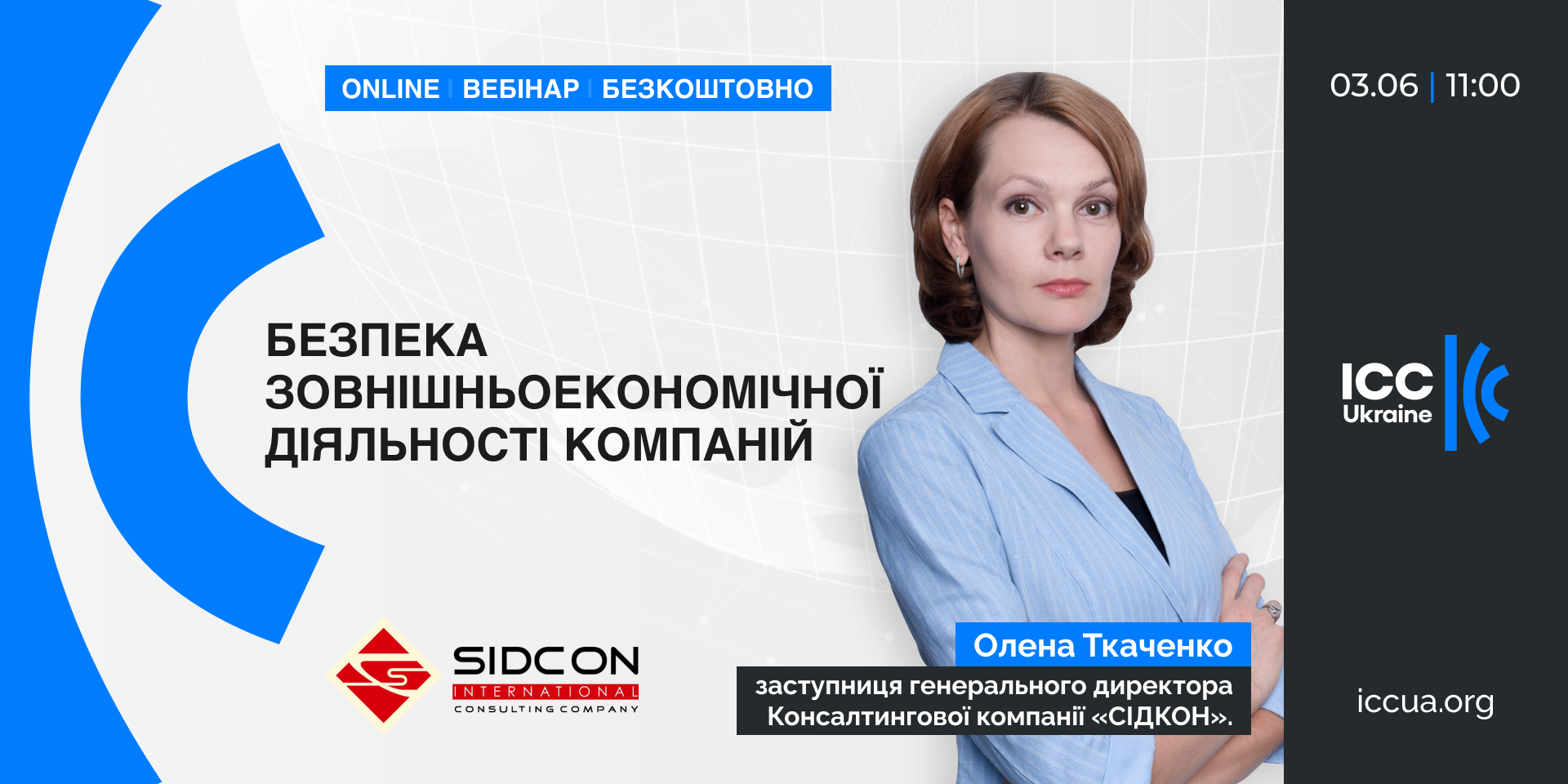
Security of Foreign Economic Activity and Fraud Protection: ICC Ukraine and SIDCON Held a Practical Webinar for Exporters
On June 3, 2026, the Ukrainian National Committee of the International Chamber of Commerce (ICC Ukraine), in cooperation with the…
04.06.2026
eATA Carnet
The eATA Carnet system digitalizes traditional paper ATA Carnets and their lifecycle management process, allowing users to initiate and track…

02.06.2026
Ukraine needs an “Infrastructure Ramstein” to support railways and logistics during the war
Volodymyr Shchelkunov, Chair the of ICC Ukraine: — The fifth year of the full-scale war has demonstrated that Ukraine’s transport…

01.06.2026
Ukrainian Business in Switzerland: ICC Ukraine Hosted a Practical Webinar for Entrepreneurs
How to Turn the "Expensive and Complex" Stereotype into a Working Success Strategy? On April 29, the International Chamber of…

06.05.2026
ICC Ukraine and the Ukrainian Bar Association have signed a memorandum of cooperation
The Ukrainian National Committee of the International Chamber of Commerce (ICC Ukraine) and the Ukrainian Bar Association (UBA) have signed…

28.04.2026
Integration Forum “Paths and Financing for the Recovery of Territorial Communities: Strategy 2026” in Ivano-Frankivsk
April 23, 2026, in Ivano-Frankivsk, the Integration Forum “Paths and Financing for the Recovery of Territorial Communities: Strategy 2026” took…

27.04.2026